THE LINUX FOUNDATION PROJECTS
Category

Newsletter

Fifteen Years In, Quietly Everywhere

By Newsletter

DPDK Dispatch · Q3 2026

Fifteen Years In, Quietly Everywhere

August 2026 · 4 owned stories · Ecosystem reading list · APAC roundup

In this issue
  • Fifteen Years In, Quietly Everywhere
  • Q2 at a Glance
  • DPDK Summit Stockholm 2026: Session Highlights
  • Q2 in Releases: 25.11 Ships in Ubuntu LTS
  • Grout at Two Years: Router Reaches Debian
  • Tim O’Driscoll: The View from the Governing Board
  • NXP and the 20-Millisecond Requirement: Suchit Lepcha on i.MX 95
  • A Day in the Life of a Packet: Part 3
  • Ecosystem reading list
  • APAC community roundup

The Stockholm summit in May put DPDK’s scope in one room: cryptographic offload into post-quantum, embedded RISC-V cores inside NICs, a wireless forwarding plane, Kubernetes-native routing, and deployment work under CERN’s prototype detectors and the DUNE neutrino observatory.

Awareness has kept up in 2026. A website refresh brought dpdk.org and core.dpdk.org under a single navigation, so developers who land on a blog or spotlight now move through to the roadmap, security process, and mailing lists without hunting. China continues to lead discovery, and the new WeChat channel built with Feng Chengwen at Huawei and Yong Wang at ZTE, with Bilibili launching soon, is making that audience visible inside the project rather than only in the analytics.

The contributor picture is more mixed. 55 new authors landed patches in H1 2026, nearly double the H2 2025 count, but the reviewer share of new entries fell from around 29 percent to around 8 percent. More people are showing up. Fewer are reviewing. DPDK is a sophisticated project to onboard, and reviewing takes no commit access. dpdk.org/review-your-first-patch is where H2 focuses new participation.

From the Governing Board, Tim O’Driscoll names four open questions for the next phase: DPDK’s place in AI infrastructure, its role in the Ultra Ethernet Consortium’s software stack, deeper crypto acceleration for network security, and reach into hyperscalers who already use it silently. He also names a tension the numbers cannot see. DPDK runs quietly in Formula 1 teams, radio telescopes, and high-frequency trading, and the users who depend on it most are the ones least visible in the mailing lists.

Fifteen years of API discipline means new hardware, new fabrics, and new workloads land against a stable interface. That is the direction: not a pivot, but the same layer taking on more.

Q2 at a Glance

Q2 tightened several long-running threads into the same shape. Ubuntu 26.04 LTS shipped with DPDK 25.11 as the default, closing a gap that used to run a release or two. Grout crossed from experiment into production, with FRR integration, an OpenShift deployment story, and a Debian packaging intent filed. NXP’s i.MX 95 landed on NVIDIA’s Holoscan Sensor Bridge partner list as the only microprocessor in the group, closing a 20-millisecond sensor budget where the kernel networking path could not. CERN’s DUNE programme is targeting 15 Tbit/s per detector supermodule across roughly 40 nodes. Bob McMahon’s summit talk put 802.11 itself on the table. AMD Pensando Salina, HPE’s second-generation smart switch, and CAICT naming the DPU as the third main chip alongside CPU and GPU all landed in the same twelve weeks.

Featured · Event

DPDK Summit Stockholm 2026: Session Highlights

The two-day program at Scandic Continental covered rte_flow offload limits (Pavlina Patova), AI-assisted formal verification of the eBPF verifier (Mahsa Khalili, Claudia Cauli, Konstantin Ananyev), CI stress-testing with LLMs (Aaron Conole and Stephen Hemminger), embedded RISC-V cores on a NIC (Dmitry Kozlyuk), Multithreading on Eventdev (Mattias Rönnblom), and deployment stories from CERN’s prototype detectors, DUNE, ByteDance, and NXP. Thomas Monjalon closed. Session recordings drip weekly on the DPDK Project YouTube channel and syndicate through LinkedIn.

Watch the playlist.

Featured · Releases

Q2 in Releases: 25.11 Ships in Ubuntu LTS

Five stable releases landed in Q2 across three LTS branches: 24.11.5 on 15 April, 25.11.1 on 21 April, 25.11.2 on 1 May, 23.11.7 on 5 May, and 24.11.6 on 19 May. 26.07-rc1 followed on 11 June, opening the next major cycle.

Downstream tracked closely. Ubuntu 26.04 LTS “Resolute Raccoon” shipped on 23 April with dpdk 25.11-2 as the packaged default, the first Ubuntu LTS to carry the current 25.11 line. Debian uploaded 25.11.1-1 to unstable on 23 April and 25.11.2-1 on 7 May, migrating to testing within days each time. Both distributions skipped the 24.11 backport channel to move straight to 25.11.

Release notes · Ubuntu package · Debian tracker.

Featured · Hosted Project

Grout at Two Years: Router Reaches Debian

Grout, the DPDK-hosted graph router, had three sessions on the Summit programme: Grout: Two Years In (Robin Jarry), Integrating FRR with Grout (Jarry and Maxime Leroy), and Running a High-Performance DPDK-Based Router on Kubernetes (Andrea Panattoni). The two-year framing anchors the project’s move from prototype to something distributions can package.

Jarry filed the Debian Intent-to-Package for Grout 0.16.0 on 11 June. The declared feature set covers IPv4 and IPv6 forwarding, L2 bridging, IP-in-IP tunnels, stateless DNAT44 and stateful SNAT44 with conntrack, SRv6, DHCP client, and FRR integration through the zebra dplane plugin. Configuration runs over a UNIX socket API and the grcli shell.

Grout on GitHub · Debian ITP #1139685.

Community Spotlight

Tim O’Driscoll: The View from the Governing Board

Tim O’Driscoll became DPDK’s Governing Board Chair after nearly two decades at Intel and a front-row seat on the project’s move to the Linux Foundation. He reflects on the invisible users, the contributor base’s tilt toward hardware vendors, and the technical questions that will define the next phase.

“It’s all about being on the inside setting the direction rather than on the outside looking in, having to follow a direction set by others.”

Read the full story.

User Story

NXP and the 20-Millisecond Requirement: Suchit Lepcha on i.MX 95

An industrial robotics customer asked NXP to hit 20 milliseconds end-to-end for sensor streaming. Suchit Lepcha’s team met the number on the i.MX 95 microprocessor, which is now the only microprocessor in NVIDIA’s Holoscan Sensor Bridge ecosystem. The piece walks the path from the constraint back through the datapath to where DPDK carries the load.

Read the full story.

Day in the Life

Day in the Life Part 3

Part 3 of the series looks at what running a hosted Linux Foundation project actually involves week to week, from summit logistics through board coordination to the working groups that keep the project moving.

Read the full story.

Ecosystem reading list

Third-party coverage and technical writing that intersects with DPDK’s work this quarter.

Enable Real-Time AI for High-Speed Data Acquisition with DAQIRI

NVIDIA Developer Blog covers A-GHOST at CERN, where FPGA-based hardware feeds a GPU farm over UDP and RoCE v2 at hundreds of Gbps. Direct thematic pair to the Q1 CHIME piece.

A Configurable Integration Framework for AGF and UPF on Heterogeneous Programmable Data Planes

Peer-reviewed 5G paper in MDPI Network, published 3 June. Combined AGF/UPF deployment shows lower end-to-end latency than separated. DPDK named in the keyword set.

HPE Strengthens Its Grip on the Smart Switch Market

Fierce Network on the CX-10040 platform, HPE’s second-generation distributed services switch, built with AMD Pensando. Adds 100G and 400G options to the range. Context for teams tracking the DPU and smart switch adjacencies to DPDK.

APAC community roundup

Institutional analysis and engineering deep-dives from the APAC region this quarter.

CAICT DPU Development Analysis Report (2026)

CAICT’s Cloud Computing and Digitalisation Institute released its 2026 Chinese DPU industry report in May, framing DPU as the third main chip of the computing infrastructure and placing DPDK in the pre-DPU software acceleration lineage. Highest-authority APAC document of the quarter.

DPDK rte_ring Compared with Go Channels, crossbeam-channel, and LMAX Disruptor

Chinese-language engineering write-up from the 土法炼钢 collective, published 8 May. Treats DPDK’s ring library as reference material against Go and Rust concurrency primitives and closes with a full C implementation of a bounded MPMC queue.

eBPF Network Subsystem Evolution: From Hook to Programmable Network OS

Companion Kubernetes-networking piece from the same collective, published 3 April. Traces the eBPF subsystem across XDP, struct_ops, AF_XDP, SmartNIC integration, and P4 tie-ins.

Get involved with DPDK

DPDK runs on code review. The fastest way to help this quarter is to read one patch and reply to the thread with an honest question or comment. You do not need commit access. You do not need to have contributed before.

Review your first patch. Contribute your first patch. Past newsletters.

DPDK Project · A Linux Foundation Project · dpdk.org
DPDK Dispatch Q1 2026

By Newsletter

DPDK Project  ·  Q1 2026 Newsletter

Fifteen years in,
and the work keeps getting better

Summit 2026 is six weeks away. Five new articles. One APAC roundup. Here’s what the community published this quarter.

March 2026
5 owned stories
Ecosystem digest
APAC roundup

DPDK turned fifteen last quarter. The community published five pieces that tell different parts of that story — where the project came from, how it governs itself, who runs it in production, and where it goes next. Alongside those, the ecosystem continued to move: enterprise Linux is catching up with modern networking stacks, observability tooling is evolving fast, and DPDK is turning up in places that would have surprised the original architects — from radio telescopes to DDoS mitigation. Summit 2026 is six weeks away. There is a lot to cover.

Featured  ·  Event

DPDK Summit 2026  ·  May 12–13  ·  Stockholm

What to Watch at DPDK Summit 2026: Routers, Offloads, Verification, and Real-World DPDK

The full schedule is live. Two days in Stockholm cover production routing with Grout and FRR, rte_flow offload limits, eBPF observability, AI-assisted formal verification, CI integration, and deployment stories from CERN, Ericsson, ByteDance, and more. Speakers include Stephen Hemminger, Bruce Richardson, Mattias Rönnblom, Robin Jarry, Aaron Conole, and others from across the ecosystem. A virtual attendance option is available.

“The strongest schedules do more than fill time slots. They show where a project is headed.”

The all-attendee reception on Tuesday and BoF sessions on Wednesday are where follow-up questions turn into real collaboration. Review the schedule before you register.

Read the session preview and register →

Community & Project

Community Spotlight

DPDK at 15: From Intel’s Internal Experiment to Open Source Foundation

Jim St. Leger was there when Venky Venkatesan and a small Intel team were running internal experiments on user-space packet processing with no plan to build a community around it. This piece traces the path from closed code to Linux Foundation project — the architectural bet on polling mode drivers, the decision to move control to dpdk.org in 2014, and the harder cultural shift that followed. It is also a tribute to Venky, whose design decisions still define DPDK fifteen years on.

“When you go into an open source community, you take your company hat off. You sit there with people that are your competitors and you go build something that’s better for all.”

Read the full story →

Community Spotlight

Fifteen Years of Getting Stronger: What DPDK’s Community Built Together

Rashid Khan led Red Hat’s DPDK efforts and chaired the Governing Board during a sustained growth phase. When he reflects on fifteen years, he reaches for a word most engineers would consider a compliment: boring. Khan discusses 100% member retention, mandatory testing through UNH-IOL, governance transparency, and why power efficiency is the community’s next hard problem.

“In the Linux environment ‘boring’ is good. DPDK strives to become boring. Meaning it is easy to deploy, and it just works out of the box.”

Read the full story →

Community Spotlight

Thomas Monjalon: Twelve Years of Building DPDK’s Open Source Community

Thomas Monjalon became one of the first DPDK maintainers from outside Intel in 2013. Twelve years on, he talks about what it actually took to earn trust from competing vendors, why the hardest bugs to fix are in governance, and what daily maintainership looks like across a community spanning Intel, Marvell, NVIDIA, NXP, and dozens of independent contributors. A candid account of the work that does not appear in commit logs.

“It took years to build trust through actions, not just words.”

Read the full story →

User Story

How CHIME’s Correlator Team Uses DPDK to Turn Raw Sky into Science

At the Canadian Hydrogen Intensity Mapping Experiment, the bottleneck was not telescope time — it was host memory bandwidth. FPGAs push UDP from thousands of digitizers at over 6.4 Tb/s. The GPU correlators need that data arranged in exact matrix tiles, in one pass, with no reorder step. Andre Renard’s team used DPDK poll-mode drivers and Intel DDIO to inspect headers in L3 cache and scatter payloads directly into GPU-ready DRAM offsets, halving memory operations per byte. The same Kotekan pipeline now runs across multiple telescope sites.

“DPDK let us look at the header while it was still in L3 and write the payload exactly where the GPU expects it.”

Read the full story →

Ecosystem reading list

Third-party coverage and technical writing that intersects with DPDK’s work this quarter — networking stacks, observability tooling, Kubernetes performance, 5G efficiency, and high-frequency trading infrastructure.

The State of Enterprise Linux for Networking →

How enterprise Linux distributions are evolving for modern networking stacks, and where they sit alongside purpose-built network operating systems. Useful context for teams evaluating deployment environments for DPDK-based applications.

Engineering Absolute Determinism: Advanced Low-Latency Optimization in High-Frequency Trading →

Ultra-low-latency tuning for trading systems — deterministic performance, jitter reduction, and infrastructure-level optimization. Reflects continued demand for the kind of predictable, high-throughput packet handling that DPDK was designed for.

Via Walletinvestor.com

OpenTelemetry Collector Contrib v0.145.0: 10 Features That Will Transform Your Observability Pipeline →

Ten notable additions in the contrib release, covering telemetry collection and pipeline flexibility. As observability tooling around high-performance datapaths matures, OpenTelemetry’s trajectory is worth tracking alongside DPDK’s own CI and verification work.

Optimizing Kubernetes Networking for High-Performance Cloud Applications →

A look at Kubernetes network tuning for cloud-native workloads — pod-to-pod performance, service routing overhead, and scaling under load. Complements the Summit’s sessions on Kubernetes-based routing and cloud-native DPDK deployment.

The Efficient 5G Core: Intel and Nokia on CoSP OPEX Reduction →

How Intel and Nokia are approaching 5G core efficiency through power and performance optimization — territory that overlaps directly with the DPDK community’s current thinking on power-aware packet processing and many-core scaling.

APAC Community Roundup (MANDARIn Language ARTICLE LINKS)

Active research and deployment work from the APAC region this quarter, spanning performance optimization, emerging transport architectures, cloud DPU integration, and new application domains for DPDK-based tooling.

Huawei & Zhejiang University — fast-path forwarding improvements for smaller rule sets →

Forwarding optimizations that improve DPDK performance at smaller rule set sizes, contributing to core fast-path efficiency work.

Huawei  ·  Zhejiang University

DPDK-based latency jitter measurement for precision network validation →

A new testing approach focused on jitter measurement, showing DPDK being applied in precision validation contexts well beyond standard packet forwarding.

BURST soft-RDMA stack and 400G transport research →

DPDK positioned as part of emerging 400G transport and software-defined RDMA architecture research, pointing toward next-generation interconnect work.

Hunan University  ·  ByteDance

China Mobile Cloud — DPU-accelerated load balancer design →

A DPDK-based load balancer combining CPUs, DPUs, and smart NICs, reflecting DPDK’s growing role in cloud architectures that distribute work across heterogeneous silicon.

China Mobile Cloud

OVS-DPDK in telecom and finance deployments →

Continued production coverage of OVS-DPDK where low jitter, hardware offload, and high-throughput handling are hard requirements — not aspirations.

ARM-based financial monitoring with DPDK →

Strong performance gains reported for real-time infrastructure observability on ARM, extending DPDK’s value beyond traditional networking appliance deployments.

DPDK as high-speed ingestion for AI-driven traffic analysis →

Coverage connecting DPDK with AI-driven traffic analysis pipelines, reinforcing its role as a high-rate data ingestion layer in modern security infrastructure.

Oracle-linked coverage

DPDK as a high-rate offensive testing engine →

Security reporting framing DPDK’s packet-processing speed as a capability in cyber tooling and offensive testing contexts.

P4-DPDK in DDoS defense →

Continued interest in combining programmable data planes with user-space packet processing for DDoS mitigation.

Get involved with DPDK

DPDK runs on code review. Every patch that goes into a release was read by someone who asked a careful question or caught a subtle issue. You do not need commit access to contribute — just the ability to read code and give honest feedback. Summit 2026 registration is open now.

DPDK Project  ·  A Linux Foundation Project  ·  dpdk.org
Q1 2026  ·  Newsletter archive

DPDK Dispatch Q4 – The Quarterly Newsletter

By Newsletter

Welcome to the Q4 DPDK Dispatch, your quarterly update on the latest developments, insights, and highlights from the open source community driving the evolution of high-performance network software and applications.

Main Announcements

  • The DPDK Summit 2026 is confirmed and we’re looking at several European cities for the first week of June with more info to come!
  • Heads up, the DPDK major release 25.11 LTS arrives next month with many new drivers

Blogs, User Stories and Developer Spotlights

Check out a new hybrid project user story with Guvenc Gulce, Malte Janduda, Jaromír Smrček, and Tao Li who designed dpservice. Learn how dpservice combines DPDK, Kubernetes, and SmartNICs to deliver wire-speed, cloud-native.

Read it here →

See how Tobias Roeder at ipoque – a Rohde & Schwarz company uses DPDK to power 5G cores, UPFs, and secure edge infrastructure, in our latest user story.

Read it here →

Planning your next DPDK upgrade? Start here. New updates in 22.11.10, 23.11.5, and 24.11.3 strengthen LTS branches for production across telecom, enterprise, and cloud—backed by targeted fixes and broad community support.

Read the update here →


Learn how to quickly clone the DPDK repository and run its end-to-end test suite (DTS) in just minutes. Understand the structure of a DTS test suite—covering setup and teardown, naming conventions, documentation standards, and practical examples using the DPDK TestPMD application.

Whether you’re a new contributor or a seasoned developer looking to understand DPDK’s testing framework, these videos provides a clear, hands-on introduction to DTS.

Watch the videos →


DPDK & Technologies in the news:


Performance Reports & Meeting Minutes


This newsletter is sent out to thousands of DPDK developers, it’s a collaborative effort. If you have a project release, pull request, community event, and/or relevant article you would like to be considered as a highlight for next month, please reply to marketing@dpdk.org or dm Benjamin Thomas.

Want to support the community? Like and share this post!

Thank you for your continued support and enthusiasm.

DPDK Q3 Dispatch

DPDK Dispatch Q3 2025 – The Quarterly Newsletter

By Newsletter

Welcome to the Q3 DPDK Dispatch, your quarterly update on the latest developments, insights, and highlights from the open source community driving the evolution of high-performance network software and applications.

Main Announcements

DPDK Bay Area Summit Cancellation

After careful discussion with the Governing Board and Technical Board, we’ve decided to cancel the Bay Area DPDK Summit planned for September 17–18. We’ll be reaching out to all registered attendees shortly with details about refunds.

After our  successful DPDK Summit in Prague earlier this year, we definitely intend to continue the DPDK Summit events. We’ll be focusing on plans for next year, to ensure we create high-value events that bring together contributors, industry leaders, and users.

In the meantime, look out for our 15th anniversary campaign celebrating DPDK’s history, major milestones, and community contributions. If you’d like to be interviewed or have a story to share, please reach out to marketing@dpdk.org, we’d love to hear from you.

Thank you for your understanding and support. We look forward to connecting at future events soon.

celebrating 15 years DPDK

DPDK turns 15 this year, marking a decade and a half of advancing high-performance packet processing.

In the weeks leading up to the DPDK Bay Area Summit, we’ll be spotlighting key achievements and the maintainers who have guided the project and made significant contributions. If you’ve got something to share from the last 15 years, a breakthrough, a favorite moment, or memory drop it in the comments, tag @DPDK , and use #DPDK15.

DPDK Dev Spotlight with Bruce Richardson

New Dev Spotlight with Bruce Richardson

As DPDK marks its 15th anniversary, we sit down with founding developer Bruce Richardson at Intel Corporation to reflect on the project’s origins, milestones, and impact. In this special Developer Spotlight, Bruce shares insights into DPDK’s early challenges, key breakthroughs, and what’s ahead for high-performance networking. It’s the first in our 15 Anniversary series of spotlights that look into how the project has evolved, and the people who shaped it.

Read it here →

Strong Engagement & Strategic Direction Emerge from Prague Summit

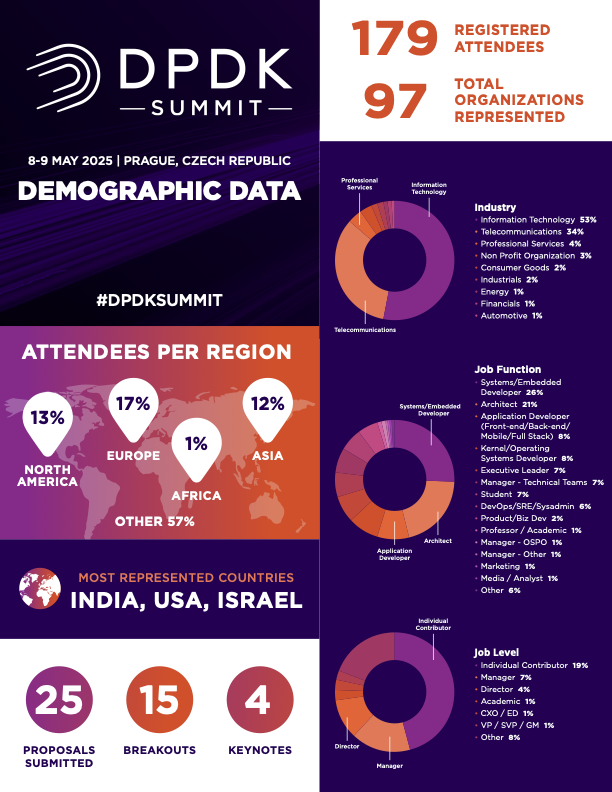
The DPDK Summit Prague featured 27 sessions and 31 speakers across a diverse technical program, attracting 179 registrants from 97 organizations. In-person attendance skewed toward systems developers and architects, while virtual attendees were led by India and the U.S. Survey feedback was unanimously positive, emphasizing networking value and session quality.

Takeaways from leadership meetings included:

  • Renewed focus on Rust support, cleaning up driver guidelines, and streamlining Bugzilla backlog.
  • Push for broader DTS adoption through single-machine usability.
  • Discussion of tech writer contract termination for cost savings.
  • Rejection of a code challenge in favor of more ROI-driven initiatives.
  • Exploration of new DPDK use cases beyond networking (e.g., AI, databases) with potential LF Research collaboration.
  • Continued emphasis on member retention and growth strategy through direct engagement.

You can all see the survey responses from DPDK Summit APAC and DPDK Summit 2024

DPDK Summit Prague Summary

A Day in the Life of a Packet

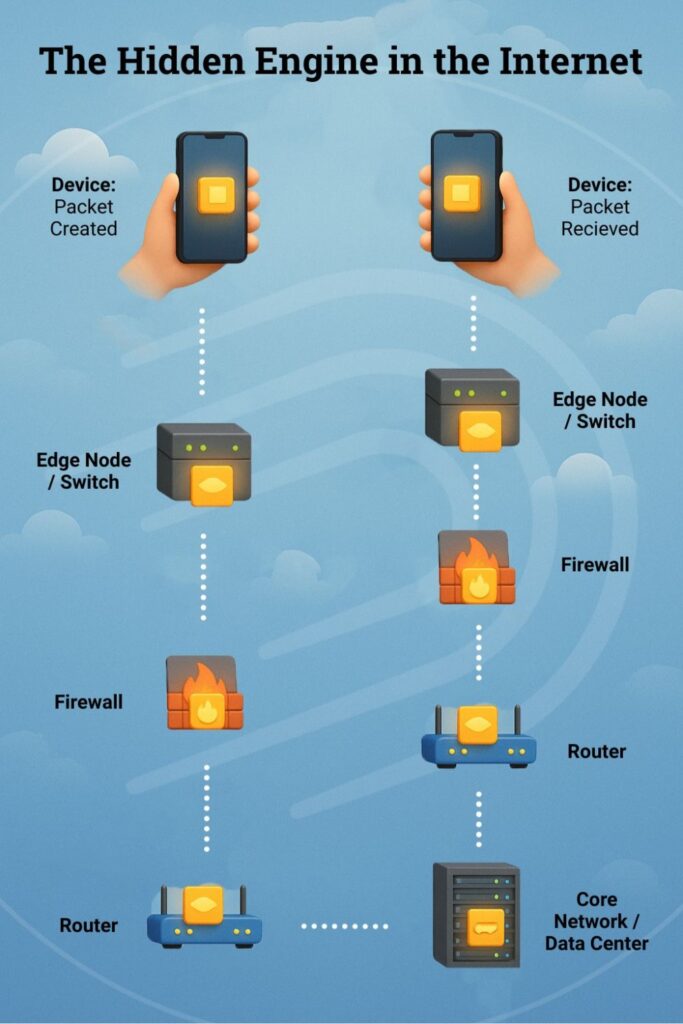
Ever wondered how a packet actually travels through a high-speed DPDK-based system? A Day in the Life of a Packet is a three-part blog series that walks you through every stage, from ingress at the NIC, through user space processing, to egress back to the network. It’s a clear, practical look at what really happens under the hood when performance matters most.

A Day in the Life of a Packet

Part 1: The Hidden Engine Behind the Internet.

Every tap, stream, and video call depends on a seamless flow of data across networks, moving billions of packets per second behind the scenes. At the core of this invisible machinery is DPDK. In this first installment, we introduce how DPDK fits into modern infrastructure and why it’s essential to the digital experiences we take for granted.

Read it here →

DPDK key stages and components in packet processing

DPDK & Technologies in the news:

Performance Reports & Meeting Minutes

This newsletter is sent out to thousands of DPDK developers, it’s a collaborative effort. If you have a project release, pull request, community event, and/or relevant article you would like to be considered as a highlight for next month, please reply to marketing@dpdk.org

Thank you for your continued support.

DPDK Dispatch Newsletter

DPDK Dispatch Feb 2025

By Newsletter

1. Main Announcements

2. Blogs, User Stories and Developer Spotlights

  • Submit a blog here
  • Submit a developer spotlight here

3. DPDK & Technologies in the news:

4. Performance Reports & Meeting Minutes

This newsletter is sent out to thousands of DPDK developers, it’s a collaborative effort. If you have a project release, pull request, community event, and/or relevant article you would like to be considered as a highlight for next month, please reply to marketing@dpdk.org

Thank you for your continued support and enthusiasm.

DPDK Team.

DPDK Dispatch Newsletter

DPDK Dispatch Jan 2025

By Newsletter

1. Main Announcements

2. Blogs, User Stories and Developer Spotlights

3. DPDK & Technologies in the news:

4. Performance Reports & Meeting Minutes

This newsletter is sent out to thousands of DPDK developers, it’s a collaborative effort. If you have a project release, pull request, community event, and/or relevant article you would like to be considered as a highlight for next month, please reply to marketing@dpdk.org

Thank you for your continued support.

DPDK Dispatch Newsletter

DPDK Dispatch December

By Newsletter

1. Main Announcements

2. Blogs, User Stories and Developer Spotlights

  • Share your latest updates here
  • Start your developer spotlight here

3. DPDK & Technologies in the news:

4. Performance Reports & Meeting Minutes

This newsletter is sent out to thousands of DPDK developers, it’s a collaborative effort. If you have a project release, pull request, community event, and/or relevant article you would like to be considered as a highlight for next month, please reply to marketing@dpdk.org

Thank you for your continued support and enthusiasm.

DPDK Team.

DPDK Dispatch Newsletter

DPDK Dispatch November

By Newsletter

1. Main Announcements

  • Read the DPDK Summit overview here.

2. Blogs, User Stories and Developer Spotlights

3. DPDK & Technologies in the news:

4. Performance Reports & Meeting Minutes

This newsletter is sent out to thousands of DPDK developers, it’s a collaborative effort. If you have a project release, pull request, community event, and/or relevant article you would like to be considered as a highlight for next month, please reply to marketing@dpdk.org

Thank you for your continued support and enthusiasm.

DPDK Team.

DPDK Dispatch Newsletter

DPDK Dispatch October

By Newsletter

1. Main Announcements

  • Discover how DPDK transcends typical network performance software for routers and firewalls, integrating deeply into global infrastructure and powering bleeding-edge applications in particle processors and radio telescopes! Read the 2024 North America Summit highlights.
  • DPDK Summit talks are now online – catch some of the top presentations.

2. Blogs, User Stories and Developer Spotlights

  • Share your latest updates here
  • Start your developer spotlight here

3. DPDK & Technologies in the news:

4. Performance Reports & Meeting Minutes

This newsletter is sent out to thousands of DPDK developers, it’s a collaborative effort. If you have a project release, pull request, community event, and/or relevant article you would like to be considered as a highlight for next month, please reply to marketing@dpdk.org

Thank you for your continued support and enthusiasm.

DPDK Team.