
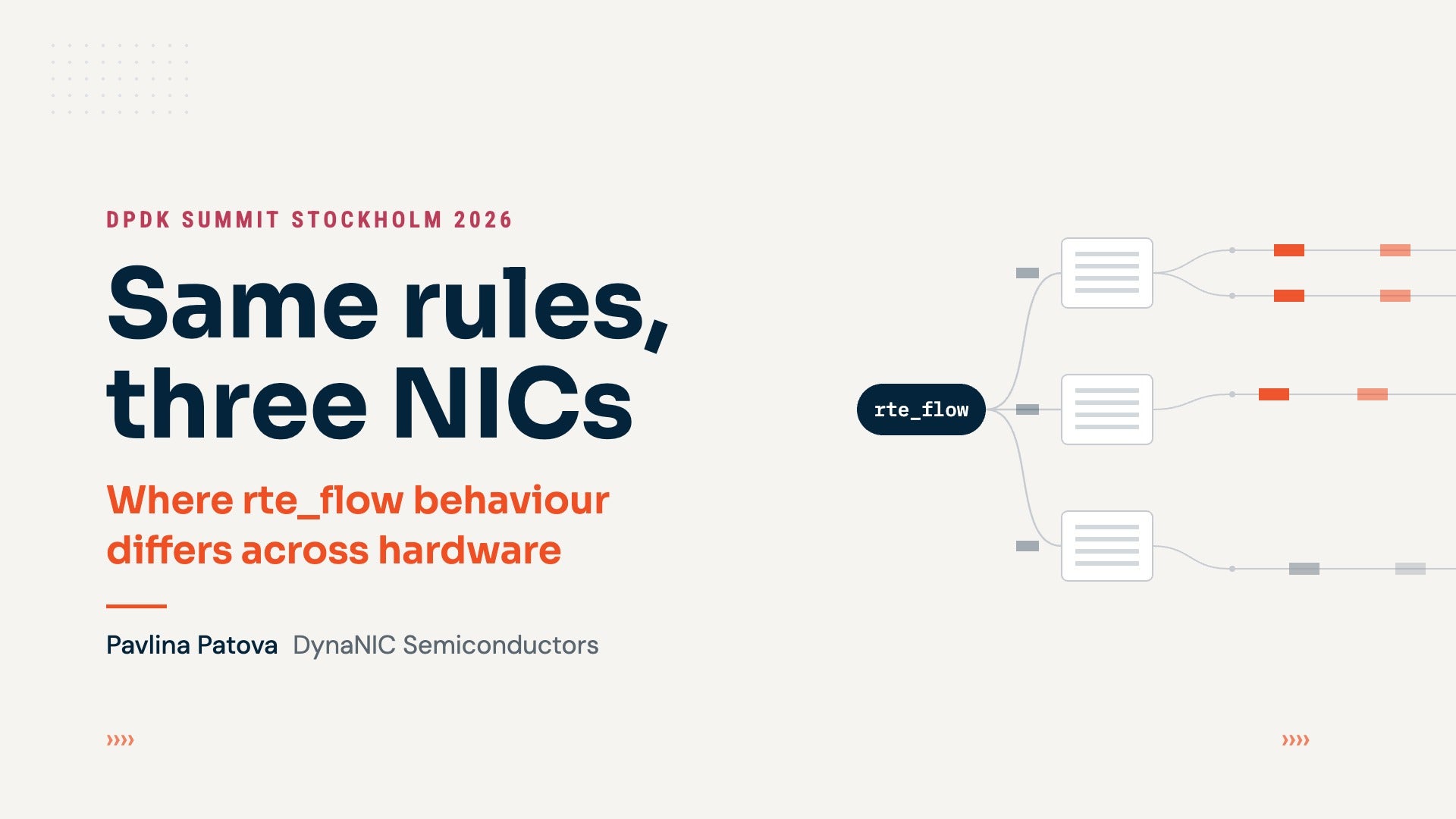
rte_flow is the DPDK API for offloading packet classification to the NIC. An application describes a rule as a pattern of header fields and a list of actions: steer to a queue, drop, count, mark, or jump to another group. Each PMD translates that rule into whatever its hardware provides.
Offload matters more as link speeds rise. Every packet the NIC classifies is a lookup the CPU does not have to run. The API is also meant to be portable, so the same rule set can run on many NICs. That holds only where rte_flow defines the result. Where it leaves behaviour undefined or device-specific, the same rules can do different things on different hardware.
DynaNIC Semiconductors is a Brno University of Technology spin-off, founded in 2021 as BrnoLogic. It provides an FPGA-based packet-processing platform for SmartNICs such as the Silicom N6010, and the platform is controlled through standard DPDK and rte_flow interfaces. The company’s work began within CESNET, the Czech research network, and that origin remains part of its story. Many of its customers use rte_flow, which makes consistent behaviour across NICs a practical concern for DynaNIC. Testing cards from several manufacturers for compatibility is part of how the company works. Pavlina Patova, a developer at DynaNIC, set out to find where the same rules behave differently across NICs. She tested the same edge-case rules on three NICs and presented the results at DPDK Summit Stockholm on May 13, 2026.
The aim was to explore practical differences in device-specific and undefined behaviour, not to treat every difference as an API violation. Where rte_flow leaves a result undefined, a difference is expected, and the testing was designed to show where those gaps are and what they mean for users.
Why they ran the tests
The team wanted to know how other NICs handle the rules DynaNIC customers write, so the nfb implementation could behave in ways users expect. They also wanted to catch misconfigurations and misreadings of the documentation. Pavlina found the documentation often did not make clear where to look for details.
The testing examined two separate things. The first is how independent PMD implementations from different NIC vendors interpret the same rte_flow rules, which is the main subject of this article. The second is DynaNIC’s own approach: it provides a common DPDK interface across its supported FPGA cards from different manufacturers. The findings below concern the first. They do not imply that DynaNIC’s own supported platforms show the same inconsistencies. CEO Pavol Korček has described testing cards from several manufacturers for compatibility with the company’s software, with the aim to “supply the entire market.”
Earlier work on the same problem
This talk is the latest in a run of DPDK work from the Brno networking community, much of it routed through CESNET.
- •2024, DPDK capture in Suricata. Lukas Sismis led Suricata’s DPDK capture integration while at CESNET, covered in the Suricata user story on dpdk.org. He found that NICs handled DPDK configuration differently, and that a consistent RSS setup took NIC-specific experimentation. He now works at DynaNIC.
- •2025, rte_flow offload for Suricata. At DPDK Summit Prague, Adam Kiripolský and Eliška Červinková of CESNET presented
rte_flowrules for Suricata: encapsulation stripping, prefiltering, and dynamic bypass of elephant and encrypted flows. They measured the results with their open-source Suricata-CI toolset. - •2026, cross-NIC behaviour. Pavlina’s talk tests how the same
rte_flowrules behave on different NICs, a question both earlier projects ran into.
Other users have hit the same gap. In his Stockholm session, Roland Sipos of CERN raised flow API inconsistencies across NICs in detector readout, and Thomas Monjalon asked from the audience for a bug report for each discrepancy. On the testing side, a 2024 DTS bug asked for the old rte_flow test suite to be ported; the new suite landed in June 2025. Patrick Robb covered DTS in his own Stockholm session.
Test setup
| NIC | PMD | Notes |
|---|---|---|
| NVIDIA ConnectX-5 | mlx5 | Default flow engine |
| Intel E810 | ice | No groups; rules are placed in one of several engines |
| Silicom N6010 with DynaNIC firmware | nfb | Trial firmware build, with table sizes increased for some tests |
Rules were created with testpmd and the C API, and observed through forward stats and flow counters. The N6010 cards run CESNET-NDK based firmware and use the nfb PMD, which Martin Spinler of CESNET maintains upstream. Larger table sizes were used solely for performance measurements. This was done to match the table sizes in other PMDs as closely as possible, so the performance comparisons are as valid as they can be.
The upstream nfb PMD does not list rte_flow support, so the flow support tested here comes from DynaNIC’s own software package. DynaNIC has published a detailed write-up of the findings.
Where the rte_flow contract leaves room
The tests found differences in five areas.
Pattern strictness. mlx5 accepted an IPv4 rule with no Ethernet item but required L3 before L4. nfb accepted an L4 match on its own. ice required a full, specific header stack, and the accepted combinations are defined only in the driver source.
Overlapping rules. The programmer’s guide states that the order between overlapping rules of equal priority is undefined, and that such a packet may take any path or be duplicated. Between them, the three NICs showed both behaviours. mlx5 duplicated the packet to both queues in group 0 and applied the first rule in other groups. ice applied the first rule. nfb applied the last.
Rule placement on ice. ice tries its engines in turn and places a rule in the first one that accepts it. The same rule could land in the switch engine on an empty table and in FDIR on a prefilled one. With default configuration, usable rule capacity cannot be predicted in advance.
Jumps. mlx5 allows jumps to any non-root group, including backward, so a rule set can form a loop. The guide warns that this is possible and undefined. A looping rule set on mlx5 left testpmd unresponsive; the cause was not debugged. nfb enforces forward-only jumps. ice has no groups.
VLAN stacks. The team sent 100 packets with one to 100 stacked VLAN headers, and matched on the underlying IPv4 header. mlx5 matched all of them, nfb matched up to five, and ice matched only the single-tag packet. Pavlina’s view is that this result reflects the parser configuration more than a fixed hardware limit. The result describes how each tested configuration handles stacked tags. It does not rank the NICs’ overall capability.
What the room said
Maintainers and vendor engineers in the audience raised technical points about the method, and these are worth keeping because they show where the results need care. Pavlina knew the order between overlapping rules of equal priority was undefined, and she tested it on purpose to see what each NIC did. The room’s objection is to relying on any order for overlapping rules, which the guide does not allow. Pavlina accepted that point, so the overlapping-rule results describe observed behaviour, not a dependable ordering.
Three other points affect specific parts of the study:
- •Shared COUNT behaviour needs shared or indirect counters, not a repeated counter ID. Any results that depend on counter sharing should be read with that in mind.
- •Insertion rate is better measured with
dpdk-test-flow-perf, including asynchronous insertion. The insertion-rate figures in this study should be treated as indicative until they are measured that way. - •Throughput is better measured with minimum-size packets. Throughput results from this study should be checked against that method before they are compared across NICs.
What has changed since Stockholm
Documentation. The rte_flow section of the programmer’s guide has had no substantive changes since May. The Doxygen move has not started in the main tree.
DTS. The flow offload suite from UNH-IOL, added in June 2025 and refactored in March 2026, tests queue, drop, modify_field and jump actions. It does not cover overlapping rules, VLAN stack depth or engine placement. Those are the areas where this talk found differences.
Parsers. DPDK 26.11 adds an internal flow graph helper that lets a PMD declare the protocol sequences it accepts as a graph. Anatoly Burakov (Intel) posted it with conversions of the ixgbe and i40e parsers, aiming for stricter, more consistent validation. A graph is also a readable statement of what a driver accepts, which addresses the pattern strictness finding. The RFC predates the summit, so this is parallel work.
Default masks. DPDK 26.11 also adds a way to query the default mask a flow item uses when the application passes none, acked by Thomas Monjalon.
Pavlina’s slides from DPDK Summit Stockholm are available on the summit schedule.
Get involved
Work on DPDK yourself
Patch review and patch submission both happen on the dev@dpdk.org mailing list. These guides walk through the workflow, from setup to your first reply or submission.
Pavlina Patova is a developer at DynaNIC Semiconductors working on DPDK and the rte_flow API. She joined CESNET while studying at Brno University of Technology. Pavol Korček is co-founder and CEO of DynaNIC. DPDK is a Linux Foundation project. Learn more at dpdk.org.